
Table of Contents
- Quick Facts & 2026 Entry Fees
- The Myth and History of Swayambhunath
- What to See at the Stupa Complex
- The Main Stupa and Wisdom Eyes
- The Great Dorje (Vajra)
- Harati Mata Temple
- How to Get There: The 365 Steps vs. The Western Road
- The Eastern Stairway (The Traditional Pilgrim Route):
- The Western Entrance (The Easy Route):
- Navigating the Monkeys: Safety Rules
- Best Time to Visit & Photography Tips
- Frequently Asked Questions (FAQs)
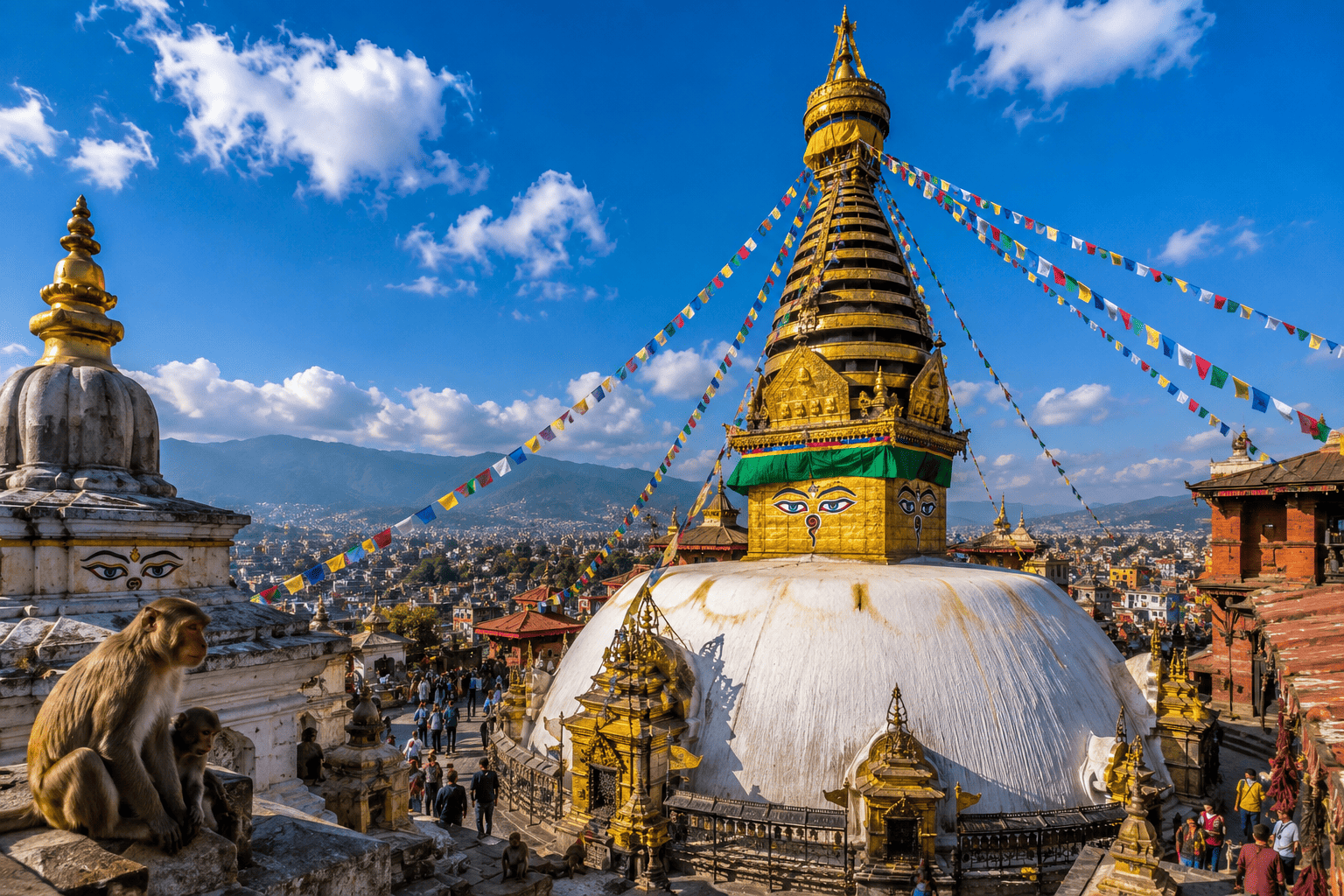
Swayambhunath (Monkey Temple): History, Religion & Travel Guide
22/08/2026
Swayambhunath, widely known as the Monkey Temple, is a
1,500-year-old Buddhist stupa offering the highest panoramic views of the
Kathmandu Valley. Located just a 15-minute drive from Thamel, this UNESCO World
Heritage site perfectly blends Buddhist and Hindu traditions. Here is exactly
what you need to know about navigating the 365 eastern steps, current entry
fees, and the site's rich mythological history.
Quick Facts & 2026 Entry Fees
Before you plan your visit, note the current logistical
details. The entry fee is collected at the main gates and goes directly toward
the ongoing preservation of the heritage site, which underwent massive
restoration following the 2015 earthquake.
|
Detail |
Information |
|
Foreign National Entry Fee |
NPR 200 |
|
SAARC National Entry Fee |
NPR 50 |
|
Opening Hours |
Open 24 hours (Sunrise to sunset is best) |
|
Distance from Thamel |
~3 kilometers (15-20 min taxi, approx NPR 300-500) |
|
Elevation |
~1,400 meters |
|
Best Months to Visit |
October to November / March to April |
The Myth and History of Swayambhunath
Swayambhunath ranks among the oldest sacred sites in Nepal.
Historical stone inscriptions confirm it was an important Buddhist pilgrimage
destination by the 5th century under King Vrsadeva of the Licchavi dynasty.
However, the site's origins go back much further in local mythology.
According to the Svayambhū Purāṇa, the Kathmandu
Valley was originally a massive prehistoric lake known as Nagdaha. A
miraculous, self-radiating lotus flower bloomed in the center of this lake.
When the Bodhisattva Manjushri used his sword to cut a gorge at Chovar, he
drained the lake to make the valley habitable. The lotus settled on this
specific hilltop and transformed into the Swayambhunath Stupa. The name
"Swayambhu" translates directly to "self-existent" or
"self-created."
In the Tibetan language, the site is called Phags.pa
Shing.kun, which means "Sublime Trees," referring to the dense,
protected forest covering the hill.
What to See at the Stupa Complex
The complex is dense with shrines, monasteries, and statues.
Take your time to explore these three key elements.
The Main Stupa and Wisdom Eyes
The physical structure is a masterclass in Buddhist
symbolism. The massive white dome represents the earth and the cycle of
creation. Rising above it is a 13-tiered golden spire symbolizing the 13 stages
of enlightenment required to reach nirvana. Painted on all four sides of the
main spire are the piercing "Wisdom Eyes" of the Buddha, looking out
across the valley. Between the eyes is the Nepali number one (Ek), representing
unity and the single path to enlightenment.
The Great Dorje (Vajra)
As you reach the top of the eastern stairway, you are
greeted by a massive, gold-plated brass Vajra (or Dorje in Tibetan). Placed on
a smooth mandala base, this represents the "thunderbolt" of
enlightenment and indestructible power in Vajrayana Buddhism. It is one of the
most photographed artifacts in the complex.
Harati Mata Temple
Showcasing Nepal’s deep religious syncretism, a major Hindu
temple sits directly adjacent to the main Buddhist stupa. The Harati Mata
Temple is dedicated to the goddess of smallpox and the protector of children.
You will constantly see local families both Hindu and
Buddhist bringing their children here to receive blessings for good health. The
line often stretches around the corner during morning pujas.
How to Get There: The 365 Steps vs. The Western Road
You have two distinct options for navigating the hill,
depending on your mobility and energy levels.
The Eastern Stairway (The Traditional Pilgrim Route):
This route involves climbing exactly 365 steep stone steps.
It begins at the bottom of the eastern hill, passing through a gate guarded by
three massive golden Buddha statues. The climb is shaded by dense forest and
flanked by pairs of stone animals (garudas, peacocks, horses, and elephants)
guarding the higher steps. This is the hardest route, but it offers the most
authentic pilgrim experience.
The Western Entrance (The Easy Route):
If you want to skip the intense cardio, instruct your taxi
driver to take you to the western entrance (often called the "back
way"). The road winds almost entirely up the hill, dropping you at a
parking lot. From there, it is only a short, relatively flat walk past a large
peace pond and several souvenir stalls to reach the main stupa level.
Navigating the Monkeys: Safety Rules
Foreign visitors nicknamed the site "Monkey Temple" because hundreds of wild rhesus macaques live in the
surrounding forest. Buddhist mythology states these monkeys grew from the head
lice in Manjushri’s hair.
While they are highly accustomed to human presence, they are
aggressive scavengers. Follow these rules to avoid getting bitten or robbed:
- Hide
all food: Do not carry visible water bottles, snacks, or fruit. They
will snatch items directly out of your hands.
- Secure
loose items: Keep sunglasses on your face or in a zipped bag.
- Do
not make eye contact: Staring at a macaque is a sign of aggression in
primate behavior.
- Do
not feed them: Feeding disrupts their natural diet and encourages
aggressive begging.
Best Time to Visit & Photography Tips
Aim to arrive at the complex around 6:00 AM. The early
morning offers the clearest views of the Kathmandu Valley before the afternoon
smog and haze build up. Sunrise light on the golden spire creates the
best conditions for photography.
Visiting early also allows you to witness the local community in action. Hundreds of local pilgrims perform their daily kora (circumambulation) around the base of the hill and the main stupa at dawn. Always remember to walk clockwise around the stupa and shrines, matching the flow of the local devotees.
Contact us at Nepal Boundary Trekking Agency Pvt. Ltd. for local guiding team to book your fully arranged Kathmandu cultural tour today.
Frequently Asked Questions (FAQs)
Q: Why is Swayambhunath called the Monkey Temple?
A: Because of the large groups of monkeys that live around the temple complex - the nickname stuck with foreign visitors over time.
Q: Is Swayambhunath a Buddhist or Hindu site?
A: It's primarily a Buddhist site, but Hindus worship here as well, reflecting how the two religions coexist closely in Nepal.
Q: How do I get to the top of the hill?
A: Either by climbing the eastern stairway (around 365 steps) or by taking the vehicle road on the other side if you prefer not to climb.
Q: Is there an entry fee for foreign visitors?
A: Yes, there's a fee at the gate. It changes periodically, so it's worth confirming the current rate before you go.
Q: Are the monkeys dangerous?
A: They're generally used to visitors but are still wild — avoid feeding them and keep an eye on bags and food.
Q: How much time should I plan for a visit?
A: An hour or two is usually enough to see the stupa, shrines, and enjoy the valley views.
Q: Can I combine this with other sightseeing?
A: Yes, Kathmandu Durbar Square is nearby and often visited on the same day.